Unity in Diversity: What Independence Day Teaches Students About Global Citizenship
Every year on 15 August, India celebrates the freedom it achieved in 1947 after a long struggle against colonial rule. School assemblies, flag-hoisting ceremonies, speeches, and cultural performances help students remember the courage and sacrifices that made independence possible.
But Independence Day can offer students something deeper than a retelling of historical events – it can help them understand how people with different identities work together toward a common purpose. That single idea, unity in diversity, is also at the heart of what it means to raise a global citizen: a young person rooted in their own culture, yet genuinely open to the wider world.
At K.R. Mangalam Global School, we treat Independence Day as exactly that kind of learning opportunity – one that connects Indian history to the attributes of the IB Learner Profile our students build every day.
What Does “Unity in Diversity” Mean?
Unity in diversity is the principle that people with different languages, religions, regions, and traditions can live and work together while still respecting what makes each of them different. It does not mean everyone thinks, speaks, or believes the same way – it means recognising a shared sense of belonging while protecting every community’s right to its own identity.
India is one of the clearest real-world examples of this idea. The country is home to hundreds of languages, multiple major faiths, and an enormous range of cuisines, art forms, and customs – differences that, rather than weakening national identity, give it its depth and character.
For students, this distinction matters. Genuine unity isn’t built by ignoring differences; it’s built by listening, challenging prejudice, and working together despite disagreement – a skill as relevant on a school project team as it is on a national scale.
Independence Was a Collective Achievement
India’s independence wasn’t secured by one person, one region, or one movement. It emerged from decades of resistance involving leaders, reformers, writers, workers, farmers, students, and ordinary citizens – each bringing a different approach to the same goal.
- Mahatma Gandhi built mass participation around non-violence and civil disobedience.
- Subhas Chandra Bose pursued a different, more militant path toward the same freedom.
- Bhagat Singh became a symbol of revolutionary courage.
- Sarojini Naidu, Aruna Asaf Ali, and Begum Hazrat Mahal, among many other women, challenged both colonial authority and social limitations at once.
- Tribal leaders and local activists, whose names rarely appear in textbooks, contributed just as decisively at the regional level.
This range of contributors is what makes independence a genuinely useful classroom topic. An inquiry-based study of it encourages students to ask:
- Whose perspectives are included in most historical accounts – and whose are missing?
- Which voices received less recognition, and why?
- How did different regions participate in the freedom movement?
- Why did people with very different beliefs support one shared national cause?
- What can modern societies learn from that cooperation today?
These questions turn independence into a collective human story rather than a list of names and dates to memorise.
What Is Global Citizenship?
Global citizenship doesn’t mean giving up national identity – it means recognising that a person belongs to a local, a national, and a global community all at once.
A global citizen understands that decisions made in one part of the world can affect people elsewhere. Climate change, public health, migration, technology, inequality, and conflict rarely stay within national borders, and addressing them requires cooperation across cultures and countries.
Global citizenship encourages students to:
- Respect cultural and social differences
- Examine issues from multiple perspectives
- Identify misinformation and stereotypes
- Understand their rights and responsibilities
- Communicate across cultural boundaries
- Participate in community initiatives
- Consider the global effects of local actions
- Work toward peaceful, sustainable solutions
What Is the IB Learner Profile – and How Does It Connect to Independence Day?
The IB Learner Profile is a set of ten attributes the International Baccalaureate uses to describe the kind of student – and future adult – its programmes aim to develop: inquirers, knowledgeable, thinkers, communicators, principled, open-minded, caring, risk-takers, balanced, and reflective.
Independence Day gives these attributes a genuinely Indian, historical context to grow in:
| IB Attribute | How It Shows Up in an Independence Day Study |
| Inquirers | Investigating different, sometimes conflicting, accounts of the freedom movement |
| Knowledgeable | Connecting historical events to present-day issues of rights and representation |
| Thinkers | Examining complex questions about identity, justice, and national belonging |
| Communicators | Expressing a viewpoint while genuinely listening to a classmate’s different one |
| Principled | Linking personal and national freedom to integrity and responsibility |
| Open-minded | Considering freedom movements and cultural perspectives beyond India |
| Caring | Recognising the human experience behind political and historical events |
| Reflective | Considering what citizenship actually asks of them, individually |
This is what makes Independence Day at K.R. Mangalam Global School an active learning experience rather than a purely ceremonial one – it’s deliberately built to develop these exact attributes.
National Pride and Global Awareness Can Coexist
National pride is sometimes wrongly framed as the opposite of global citizenship. In reality, students can take pride in their country while staying genuinely open to learning from the rest of the world.
A secure understanding of one’s own history and culture gives students the confidence to engage respectfully with others. A student who understands India’s struggle for self-determination is often better placed to recognise why dignity, representation, and freedom matter to people everywhere else too.
This is a balanced form of patriotism – one that doesn’t depend on claiming any single nation or culture is superior. It values the country’s achievements, acknowledges its ongoing challenges, and accepts a personal share of responsibility for its progress. Global citizenship begins in that honest space between belonging and responsibility.
What Independence Day Teaches About Freedom
Freedom is often understood simply as the ability to make choices. Independence also demonstrates that freedom comes with responsibilities attached.
Citizens are free to express opinions, practise their beliefs, and pursue opportunities – and, at the same time, responsible for respecting others’ rights, following just laws, and participating constructively in society.
Students meet this exact trade-off in everyday school life. They’re free to share an opinion in a classroom discussion, but responsible for letting classmates speak too. They’re free to post on digital platforms, but responsible for not spreading harmful or unverified information. These small, repeated moments are where students actually learn that freedom is most meaningful when paired with empathy, integrity, and accountability.
Learning to See Multiple Perspectives
International-mindedness develops when students genuinely try to examine a topic from more than one point of view – and Independence Day offers several natural openings for that.
Students can investigate how freedom was experienced differently across communities, compare peaceful and revolutionary approaches to the same goal, or study the relationship between independence and Partition. They can also compare India’s movement with freedom struggles in Africa, Asia, and other regions – not to rank which was “more important,” but to identify the recurring human concerns underneath all of them.
This mirrors the IB’s own emphasis on inquiry and reflection: moving students away from passive memorisation and toward evaluating evidence, recognising bias, and forming their own informed conclusions.
Turning Reflection Into Responsible Action
Global citizenship shouldn’t stay confined to classroom discussion. Learning becomes far more meaningful when students act on what they’ve understood. At school, that can look like:
- Researching an overlooked freedom fighter
- Recording family memories connected to national history
- Creating multilingual presentations on India’s diversity
- Organising a community cleanliness initiative
- Learning the correct use of national symbols
- Discussing constitutional rights and fundamental duties
- Supporting an environmental conservation project
- Designing an awareness campaign against discrimination
- Comparing freedom movements across different countries
These activities connect history to present-day responsibility – showing students that citizenship is something practised through everyday choices, not something performed only on national holidays.
How K.R. Mangalam Global School Brings This to Life
At K.R. Mangalam Global School, students are encouraged to examine India’s history through multiple perspectives while developing the qualities needed to participate meaningfully in an interconnected world. Through inquiry-led learning, structured reflection, and real classroom action, students come to see their national identity and their international-mindedness as complementary – not competing – goals.
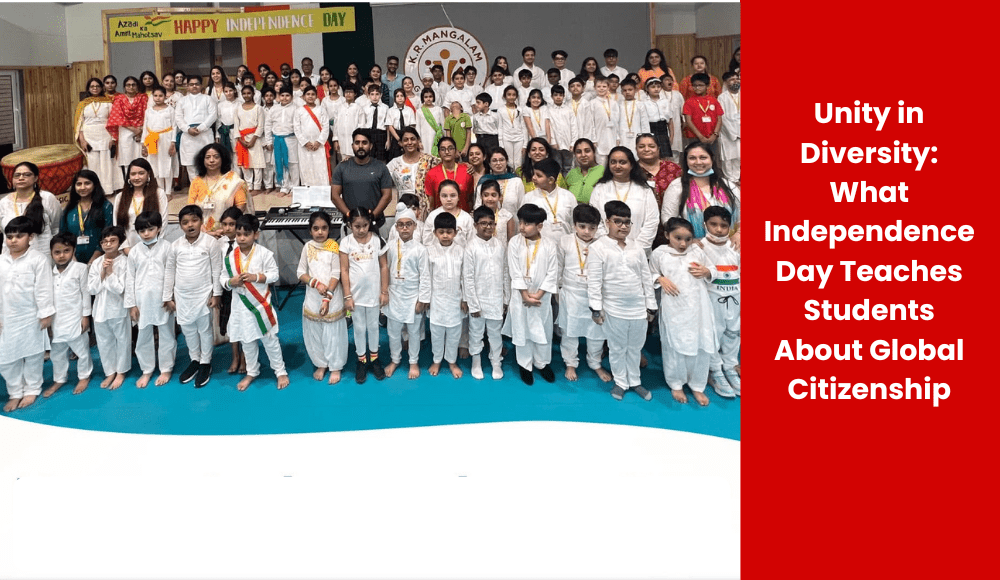
This isn’t just a classroom exercise – it plays out every year at our Independence Day assembly, where students bring the day to life through spirited patriotic dances and songs, celebrating the ideals of freedom and unity as a school community.
Frequently Asked Questions
Q1) What does “unity in diversity” mean?
Unity in diversity means people from different backgrounds, languages, religions, and cultures live and work together while still respecting each other’s differences. It doesn’t require sameness – it requires a shared sense of belonging alongside mutual respect.
Q2) What is the IB Learner Profile?
The IB Learner Profile is a set of ten attributes – including being an inquirer, thinker, communicator, and reflective learner – that the International Baccalaureate uses to describe the kind of student, and future global citizen, its programmes aim to develop.
Q3) How is global citizenship different from patriotism?
They aren’t opposites. Global citizenship means recognising you belong to local, national, and global communities at once, while patriotism is pride in your own country. A student can hold both – national pride grounded in an honest understanding of history, alongside genuine openness to other cultures and perspectives.
Q4) Why is Independence Day an important learning opportunity for students?
Beyond marking a historical event, Independence Day gives students a real, India-specific case study in how people with different identities cooperate toward a shared goal – a skill directly connected to global citizenship and international-mindedness.
Conclusion
Independence Day reminds students that India’s freedom was made possible by people who differed in language, region, belief, and background, yet found the courage to work toward a shared purpose.
That lesson stays relevant in a world where communities are more connected than ever, yet often more divided. Unity in diversity teaches young people that cooperation doesn’t demand uniformity – it requires respect, dialogue, and a willingness to protect the dignity of others.
When students understand freedom as both a right and a responsibility, they start to see citizenship differently: they can stay rooted in their national identity while contributing thoughtfully to the wider world. That’s where the spirit of independence meets the promise of global citizenship.