Difference Between Curricular and Co-Curricular Activities: A Complete Guide for Parents
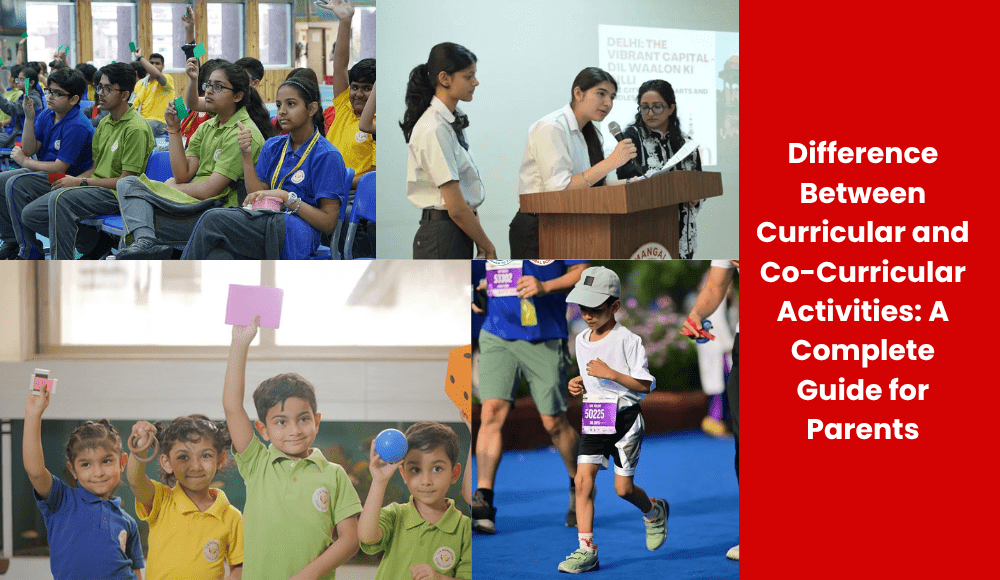
Ask any parent researching schools today and you’ll hear the same two words come up again and again: curricular and co-curricular. They sound similar, they’re often used loosely, and yet they describe two very different halves of a child’s education. Understanding the difference between curricular and co-curricular activities isn’t just useful vocabulary – it directly affects how you evaluate a school, and how confidently your child develops both academically and personally.
At K.R. Mangalam Global School, this distinction sits at the heart of how the IB framework – spanning the Primary Years Programme (PYP), Middle Years Programme (MYP), and Diploma Programme (DP) – is designed. Neither half of a child’s timetable is treated as optional. Here’s exactly what separates the two, why both matter, and how a well-structured school brings them together.
What Are Curricular Activities?
Curricular activities are the formal, syllabus-driven components of a school’s academic programme. They form the core of what a student is required to learn, are scheduled within the regular timetable, and are assessed through structured methods like tests, assignments, and examinations.

Common examples include:
- Mathematics and the sciences
- Language and literature
- Social studies and history
- Computer science and technology
The purpose of curricular learning is straightforward: build a strong knowledge base, develop analytical and reasoning skills, and prepare students to meet defined academic benchmarks — in K.R. Mangalam Global School’s case, those set by the IB continuum.
What Are Co-Curricular Activities?
Co-curricular activities run alongside the formal curriculum rather than outside it. They’re school-organised, teacher-supervised, and closely tied to a student’s overall learning goals — but they’re evaluated differently, usually through participation, reflection, or portfolio-based assessment rather than marks.

Common examples include:
- Debate, Model United Nations, and public speaking
- Sports and athletics
- Music, dance, and theatre
- Visual arts and design
- Robotics, coding, and STEM clubs
- Community service and social outreach projects
Where curricular learning builds knowledge, co-curricular learning builds the ability to apply it — communicating an idea persuasively, collaborating under pressure, or turning a concept into something real.
Curricular vs Co-Curricular Activities: Key Differences at a Glance
The table below breaks down the difference between curricular and co-curricular activities across the factors that matter most to parents evaluating a school.
| Aspect | Curricular Activities | Co-Curricular Activities |
| Nature | Academic and theoretical | Practical, creative, and skill-based |
| Objective | Build subject knowledge and academic understanding | Build life skills, personality, and interests |
| Assessment | Formal grading through exams and tests | Participation, portfolios, or reflective evaluation |
| Timing | Within the regular school timetable | Alongside the timetable, in school-organised sessions |
| Focus Area | Cognitive and intellectual development | Emotional, social, physical, and creative development |
| Examples | Mathematics, Science, English, Social Studies | Debate, sports, music, robotics club, MUN |
Categories of Co-Curricular Activities
Co-curricular offerings generally fall into five broad categories, each nurturing a different dimension of a child’s growth:
- Literary & Communication: debate, public speaking, Model United Nations, quiz clubs
- Cultural & Creative: music, dance, theatre, visual arts
- Sports & Physical: team sports, athletics, yoga, martial arts
- STEM & Innovation: robotics, coding, science fairs, design thinking clubs
- Service & Citizenship: community service, sustainability projects, peer mentoring
A genuinely well-rounded school offers meaningful options across most, if not all, of these categories — not just one or two that are easiest to run.
Why Co-Curricular Activities Matter as Much as Academics
Parents sometimes treat co-curricular activities as a bonus rather than a priority — something to fit in if there’s time left after homework. In practice, the research and the reasoning both point the other way.
They Build Skills Exams Don’t Measure
Confidence, collaboration, leadership, and emotional regulation rarely show up on a report card, yet they’re consistently what colleges, employers, and life itself actually test for. A debate team teaches a student to think on their feet in a way no textbook chapter can replicate.
They Make Academic Learning Stick
A concept learned in a science class becomes memorable the moment a student applies it in a robotics project or a science fair. This is a core principle of the IB’s approach to inquiry-based learning — knowledge that’s applied is knowledge that’s retained.
They Reveal Strengths a Timetable Can’t
Not every child’s strongest ability is academic in the traditional sense. A student who struggles with written exams may discover real aptitude and confidence through music, sport, or design — talents that would otherwise go unnoticed in a classroom-only environment.
How K.R. Mangalam Global School Brings Both Together
As an IB World School, K.R. Mangalam Global School doesn’t treat curricular and co-curricular learning as separate tracks running side by side — the IB framework is built to weave them together deliberately.

- In the PYP, inquiry-based units of learning naturally extend into hands-on, co-curricular exploration of the same themes.
- In the MYP, service and action projects require students to apply classroom learning to real community needs.
- In the DP, the CAS component — Creativity, Activity, Service — is a formal, mandatory requirement, not an optional add-on, underscoring how central co-curricular growth is to the IB’s definition of a well-rounded learner.
This is a meaningfully different model from schools where co-curricular activities are scheduled as an afterthought at the end of the day. Here, they’re built into the philosophy of how learning happens at every stage.
Co-Curricular vs Extracurricular Activities: Clearing Up the Confusion
These two terms are often used interchangeably, but they aren’t quite the same thing.
- Co-curricular activities are organised and supervised by the school, and are intentionally linked to curricular learning goals — a Model United Nations club that reinforces a student’s social studies learning, for instance.
- Extracurricular activities happen outside the school’s formal structure, driven more by individual interest than academic alignment — private football coaching on weekends, for example.
Both are valuable, but co-curricular activities carry an added advantage: because the school designs and supervises them, they’re deliberately aligned with a student’s broader academic and developmental goals, rather than being left to chance.
Frequently Asked Questions
1. What is the main difference between curricular and co-curricular activities?
Curricular activities are the mandatory, graded academic subjects within the timetable, while co-curricular activities are school-organised, skill-building activities assessed through participation rather than formal exams.
2. Are co-curricular activities compulsory?
At most well-rounded schools, yes — though the assessment method differs from academics. At K.R. Mangalam Global School, for example, the IB Diploma Programme’s CAS component is a mandatory graduation requirement, not an elective.
3. Do co-curricular activities affect college admissions?
Increasingly, yes. Universities in India and abroad look for evidence of leadership, initiative, and well-rounded development alongside academic scores — exactly what a strong co-curricular record demonstrates.
4. What’s the difference between co-curricular and extracurricular activities?
Co-curricular activities are school-supervised and tied to curricular goals; extracurricular activities happen outside school structure and are driven by personal interest.
How to Evaluate a School’s Co-Curricular Programme
Not all co-curricular programmes are created equal. When touring a school, it’s worth asking a few pointed questions rather than relying on a glossy brochure:
- Are co-curricular activities scheduled within the school day, or squeezed in only if time permits?
- Are they supervised by trained staff, or left largely unstructured?
- Is student progress in these activities tracked and reflected on, similar to academic progress?
- Do co-curricular activities connect meaningfully to what’s being taught in the classroom, or do they run on a completely separate track?
The answers to these questions usually reveal more about a school’s real priorities than any prospectus can.
The Takeaway for Parents
The difference between curricular and co-curricular activities ultimately comes down to this: one builds what a child knows, the other builds who a child becomes. A school that treats both as equally essential — not one as core and the other as optional — is one that’s genuinely preparing students for life beyond the classroom, not just for the next exam.
If you’re evaluating schools for your child, it’s worth asking not just what’s taught, but how deliberately the co-curricular experience is designed alongside it. At K.R. Mangalam Global School, that integration is built into the IB framework itself, from the earliest years through to the Diploma Programme — because K.R. Mangalam Global School is shaping future-ready global citizens, not just exam-ready students.