IB or CBSE: How Do You Decide Which Board Suits Your Child?
It usually starts at the dinner table. One parent has heard that IB builds independent thinkers. A grandparent insists that CBSE is the safer choice. A colleague at work says it depends on where your child wants to study later. By the end of the evening, you have more opinions than answers.
The truth is that neither board is better for every child. Each has real strengths, and the right choice depends on how your child learns, where your family is headed and what you want school to feel like. This blog post breaks the decision into simple parts so you can choose with confidence.
At K.R. Mangalam Global School, GK-1, we speak to many parents who are weighing exactly this question while searching for the best school in Delhi NCR. Read on for a balanced view.
What Is the Real Difference Between IB and CBSE?
How Children Learn
CBSE follows a clearly defined national syllabus, and in recent years it has moved towards competency-based learning and skill subjects. The IB is built around inquiry. Children begin with a big question, such as “How do communities solve shared problems?”, and explore it across subjects. Both boards teach facts. The IB places more weight on asking why, connecting ideas and applying them.
Also Read : IB vs Cambridge vs CBSE
How Children Are Assessed
In both boards, examinations matter. In the IB, however, assessment also includes projects, presentations, research and reflection. In the Diploma Programme, for example, students complete an Extended Essay and an interdisciplinary Theory of Knowledge course alongside their subjects.
What Parents See Day to Day
In a CBSE classroom, parents often see clear chapter-wise progress. In an IB classroom, they are more likely to see learning journeys: units of inquiry, student-led presentations and reflections on how a child approached a task. Neither is wrong. They simply measure growth differently.
Which Board Fits Which Child?
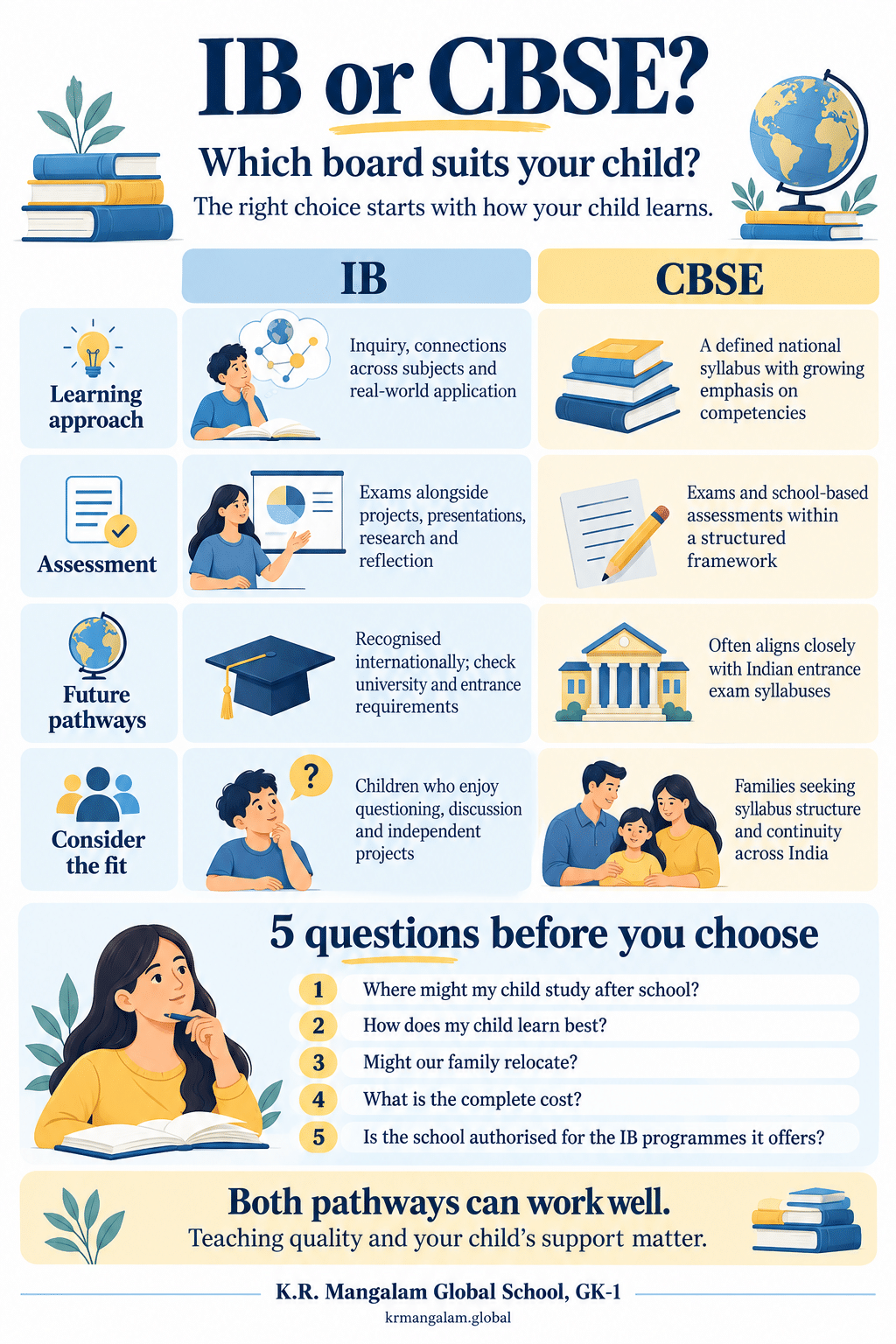
The IB often suits children who are curious, enjoy projects and discussion, and may study abroad in the future. The Diploma is recognised by universities across the world, although you should always check the requirements of specific institutions and entrance examinations.
CBSE often suits families who want a syllabus closely aligned with national-level entrance examinations, or who may relocate frequently within India and want continuity across schools.
Many children would do well in either board. What matters more is the quality of teaching and how supported your child feels.
Five Questions to Ask Before You Choose
1. Where Might My Child Study After School?
If your family is considering universities abroad, the IB Diploma is a well-recognised pathway. If your child is aiming for specific Indian entrance examinations, find out how the school supports that preparation.
2. How Does My Child Learn Best?
Some children thrive on discussion and projects. Others prefer structure and clear targets. Observe how your child approaches homework and new topics.
3. How Settled Is Our Location?
If you may move cities, consider how easy it will be to continue the same board.
4. What Is the Complete Cost Over the Years?
IB schools are often priced higher. Ask for the full fee structure, including activities and transport, so you can plan ahead.
5. Is the School Fully Authorised?
Check whether the school is an authorised IB World School and which programmes it offers. A school offering the complete continuum lets your child stay in one philosophy from the early years to Grade 12.
The IB Experience at K.R. Mangalam Global School
We at K.R. Mangalam Global School, GK-1, offer all four IB programmes: the Primary Years Programme, Middle Years Programme, Diploma Programme, and Career-related Programme. For parents, this means one consistent approach to learning from the early years to senior school.
Our teaching is student-led, with a focus on life skills such as goal setting, time management and self-awareness. Artificial intelligence and modern computer skills are part of the curriculum, and students have access to over 15 sports with dedicated coaches. Beyond academics, we involve parents through weekly newsletters that share insights into their child’s journey.
We believe this combination is what makes K.R. Mangalam Global School rank among the top 10 IB schools in Delhi for children who learn by questioning, creating and reflecting.
Frequently Asked Questions (FAQs)
Q. Is IB harder than CBSE?
It is different rather than harder. IB involves more independent research, writing and reflection, while CBSE places emphasis on a structured syllabus. Difficulty depends on the child.
Q. Can my child shift from CBSE to IB?
Many children do. The best time is usually in the earlier grades, though a school can guide you based on your child’s current level. Speak to the admissions team about the process.
Q. Will IB students face problems with Indian entrance examinations?
Preparation may require additional planning, depending on the examination. Discuss this with the school early so that your child’s plan is clear.
Q. Is IB only for children who want to study abroad?
No. While the Diploma is recognised internationally, the skills of research, communication and independent thinking are valuable in any career.
Q. Is IB education more expensive?
Fees are generally higher than in many national-board schools. Ask the school for a complete fee structure so you can plan.
Conclusion
Choosing between IB and CBSE is not about picking a winner. It is about matching a learning approach to a child. Think about how your child learns, where your family may be in ten years and what kind of daily experience you want school to offer.
Hence, as you explore the best school in Delhi for admissions for your child, visit the campus, meet the teachers and ask how learning is assessed. Then trust what you see.
To learn more about the admission process at K.R. Mangalam Global School, GK-1, connect with our admissions team on +91-9810956654 or write to info@krmangalam.global.